
Nzs treasury trap.

As a 52 year old kiwi historian, one of the questions of my life has been
“Why is my lived experience of Nz since 1984 at odds with the promises and talk of the political class, media class, and economics class?”
Accordingly I have paid close attention to life in general, and studied politics and economics in detail. But it still didn’t help me to understand the mechanism of our decline; a decline which is now acknowledged and dated by Treasury to the ‘reforms’ of ruthenasia; and usually obscured by the sugar rush economics of migration and a house price bubble.
However treasury to not name the cause of our woes, nor do they name the mechanism.
It’s the absence of public credit for capital development. It’s the laws of ruthenasia that constrict our nation, and bind us to mismeasurement.
RBNZ credit is how every budget gets filled. It’s not taxes that ‘pay’ for our govt budgets. It’s rbnz credit.
The fact of the matter is this.
“Gold is money, everything else is credit”
JP Morgan
What matters is who gets to create credit (money), and what is it used for?
Ruth Richardson is a champion of the 1%, they acknowledge that her ‘reforms’ were ‘constitutional law - amendments’; while we all remain oblivious to the fact that a nation with an ‘unwritten constitution’ like Nz effectively lacks a constitution; and constitutional powers are the sword and shield of a nation.
Or, in ruthrnasias case, the Trojan horse that allows for the capture of our economy by a private sector that seeks only profit, and lacks any public service motive.
Jim Bolger was the PM who enabled ruthenasia - against his better judgement - and in 2017 he labelled it a failure.
Meanwhile, those who Muldoon called ‘the greedies’ are gearing up for a second/third/fourth bite at the nation under the guise of ‘asset recycling’- because Nz ‘has no money’.
But as the LSAP and JP Morgan show us, ‘money’ is not the problem.
The problem is the constitutional law amendments that are destroying our productive capacity and ability to prosper.
It’s taken me three years to prove it in an evidence model that I call the treasury trap.
Please find it here.
It’s summarised in the first two pages
Treasury dates NZs economic reforms of the 1990s as having led to low public investment, low productivity, high public debt, a brain, skills, and population, drain. Although they don’t name it as such, it is, instead, simply a chronological correlation; rather than a directly observed link to ‘the far reaching reforms’ that many kiwis called ‘Ruthenasia’ which occurred at that time; reducing our national sovereignty, public wealth, public infrastructure and productive development.
Institutional mis-measurement hides housing-credit inflation; and, (with public development credit disappeared) private mortgage lending becomes the dominant channel of credit creation, shaping the structure of the economy into low risk speculative extraction. Rents.
While we don’t build what we need.
Self styled ‘entrepreneurs’ of the right wing acknowledge these as deliberate constitutional law amendments that changed our economic architecture. To ‘protect it from democracy’.
The economic reforms called ‘rogernomics’ and ‘ruthenasia’ have led to broad and measurable underinvestment in essentials and productive industries; economic inequality, increased poverty, strategic fragility, political immaturity, de-industrialisation, an annual haemorrhaging of our wealth overseas that equals 20% of our total exports, and a cost of living that consumes four fifths of most people’s income.
Prime Minister at the time, Jim Bolger, had to be almost coerced into many of the reforms by his finance minister and treasury, and he called them a failure before his death.
Legally, they seem to breach the duty of care, fiduciary duty, and duty to use honest rights and measures. To name only three.
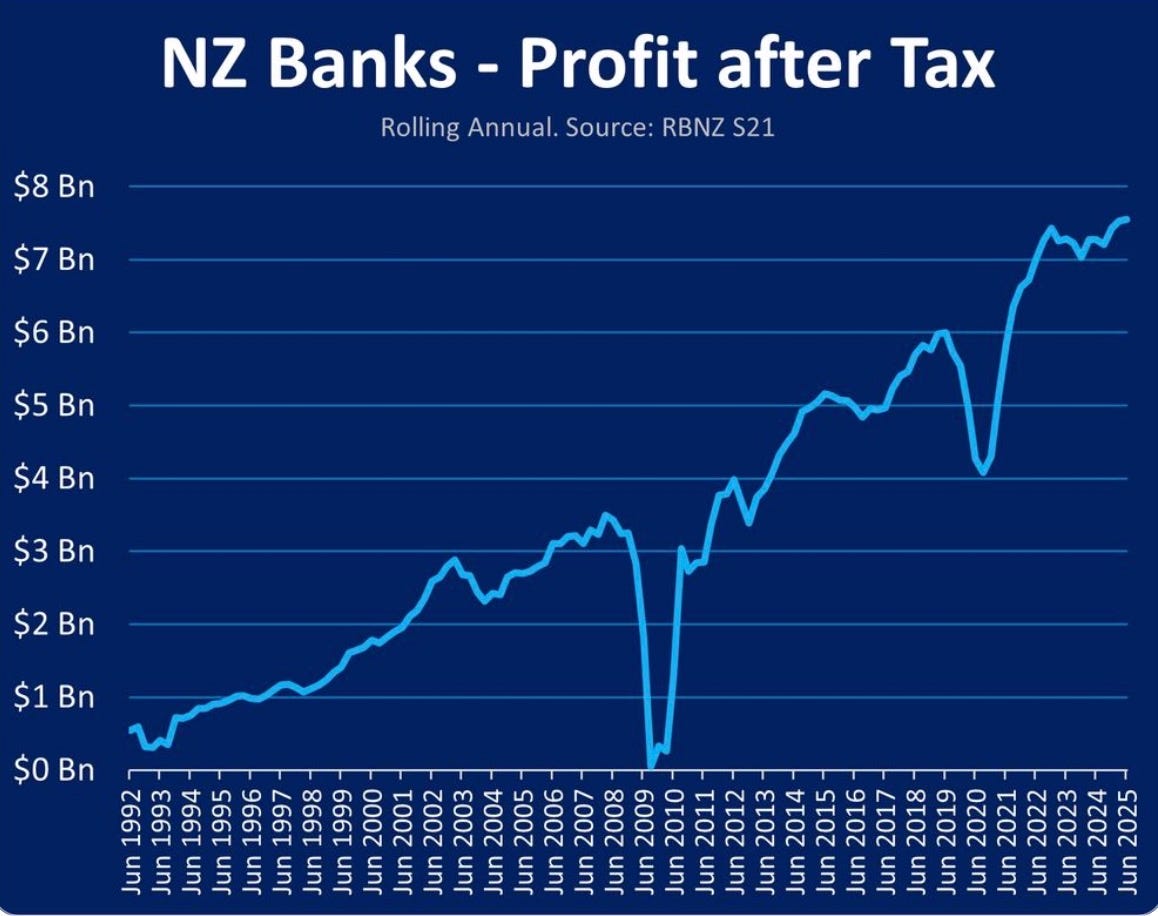
The biggest winners are Australian banks.
Historian Tadhg Stopford calls it
The Treasury Trap
The Treasury Trap is a constitutional misalignment between sovereign authority and the architecture of capital formation.
Hidden in plain sight, it explains the economic trajectory of Nz since it’s far reaching reforms of 1984-1994
When mis-measurement by public authorities obscures the dynamics of housing-credit inflation and the rising costs of essential goods and services, and when public development-credit institutions disappear/are removed/privatised without replacement,
private mortgage lending becomes the dominant channel of credit creation.
Aka Australian banks create 97% of the money/credit in our economy.
As interest bearing debt for ever more expensive houses.
Because, in such a system, the allocation of new purchasing power increasingly follows collateral incentives in land markets rather than the long-term capital-formation needs of the nation.
The structure of the economy is therefore shaped by private mortgage finance rather than by institutions responsible for national development.
We live with the consequences; a public infrastructure deficit of more than two hundred billion dollars, and an increasingly unhappy country
Because, in large part, under the Public Finance Act 1989, New Zealand adopted accrual accounting and budgeting.
Public investment increases both assets and liabilities on the Crown balance sheet.
Left pocket, right pocket, but one pockets providing a return over time.
However fiscal frameworks and political discourse emphasise liability indicators such as public debt ratios.
As a result, long-lived public investments that create productive national assets are frequently interpreted primarily as increases in government debt.
This accounting-policy interaction has discouraged sovereign capital formation even though investments expand national productive capacity.
Taken together, these institutional arrangements alter the constitutional balance of economic governance.
The state retains formal authority over currency, banking regulation, fiscal policy, and national accounting frameworks, yet the practical direction of credit creation and capital formation shifts toward private balance-sheet incentives.
Where public institutions once exercised responsibility for directing development credit toward infrastructure, housing supply, and productive industry, the absence of such institutions leaves the allocation of new credit largely to collateral-driven mortgage lending.
These developments raise constitutional questions concerning the exercise of sovereign economic powers. Governments exercising authority over monetary institutions, financial regulation, and fiscal frameworks owe duties of fiduciary stewardship, reasonable care in institutional design, and adherence to the long-standing principle of honest weights and measures in public economic measurement. If measurement systems fail to capture dominant cost pressures affecting households, and if institutional arrangements allow credit creation to be directed primarily toward asset inflation rather than productive capital formation, the alignment between sovereign authority and public purpose becomes weakened.
The constitutional implication is not that markets or private finance are illegitimate. Rather, it is that the institutional architecture governing measurement, credit creation, and capital formation must preserve the state’s capacity to steward long-term national development. When the measurement constitution obscures key economic pressures, the credit constitution delegates most money creation to collateral-driven private lending, and the capital-formation constitution constrains sovereign investment through fiscal interpretation of accounting rules, the result can be a structural misalignment between public authority and economic outcomes.
This thesis therefore examines how the interaction of measurement regimes, credit-creation structures, and fiscal-accounting frameworks has reshaped New Zealand’s economic constitution since the late twentieth-century reforms, and how those institutional arrangements influence the direction of capital formation, the distribution of financial risk, and the long-term productive capacity of the nation.
Core Evidence Ledger and solution pathway follows after Panel 3 (below).
Panel 3 Sources at end of full text
TBLR CORE LEDGER
CAPITAL FORMATION CONSTITUTION MODULE
I. GOVERNING PRINCIPLE
Economic prosperity depends on the accumulation of productive capital.
Productive capital includes:
• infrastructure
• housing stock
• industrial capacity
• agricultural systems
• energy systems
• technological capability
• human capital formation.
The process by which societies build these assets is called capital formation.
Capital formation therefore determines the long-run productive capacity of the economy.
II. DEFINITION — CAPITAL FORMATION
Capital formation is the process by which financial resources are converted into durable productive assets.
These assets generate future economic output.
Examples include:
• transport infrastructure
• energy infrastructure
• housing construction
• manufacturing facilities
• irrigation and agricultural investment
• digital infrastructure.
Capital formation is therefore distinct from consumption expenditure.
III. SOURCES OF CAPITAL FINANCE
In modern economies, capital formation can be financed through several mechanisms.
retained corporate earnings
household savings
government borrowing
public development credit
private bank credit creation
foreign capital inflows.
Each mechanism produces different institutional consequences.
IV. CREDIT AND CAPITAL FORMATION
Modern economies rely heavily on credit creation to finance capital formation.
Credit creation expands purchasing power and allows investment before prior savings exist.
This process enables:
• infrastructure development
• housing construction
• industrial expansion.
Therefore the institutional structure governing credit creation strongly influences capital formation.
V. CREDIT ALLOCATION
Credit creation alone does not determine capital formation.
The allocation of credit determines where investment occurs.
Credit allocation mechanisms may include:
• market-based lending
• policy-directed lending
• development banks
• public investment programmes
• fiscal infrastructure investment.
Where credit flows determines which sectors expand.
VI. HISTORICAL DEVELOPMENT FINANCE
Many countries historically developed institutions to direct credit toward national development.
Examples include:
• German development banking institutions
• Japanese industrial finance institutions
• South Korean development banking systems
• United States Reconstruction Finance Corporation
• agricultural credit systems in multiple countries.
These institutions were designed to support sectors where private lending was insufficient.
VII. NEW ZEALAND DEVELOPMENT CREDIT HISTORY
New Zealand historically possessed institutions that directed credit toward development.
These included:
• State Advances systems
• Housing Corporation mortgage programmes
• Development Finance Corporation
• sectoral credit programmes.
These institutions financed:
• housing supply
• agricultural expansion
• industrial investment
• infrastructure development.
This created a sovereign development-credit ecology.
VIII. INSTITUTIONAL ROLE OF DEVELOPMENT CREDIT
Development credit institutions perform several functions.
They can:
finance long-term projects
support sectors with long investment horizons
provide countercyclical lending
support national infrastructure development.
These functions often involve time horizons longer than typical commercial bank lending.
IX. PRIVATE BANK CREDIT ALLOCATION
Commercial banks allocate credit according to risk and collateral.
Bank lending decisions are influenced by:
• collateral quality
• regulatory capital requirements
• borrower creditworthiness
• short-to-medium-term profitability.
Assets with secure collateral are more likely to receive credit’s.
X. LAND AS COLLATERAL
Land possesses characteristics that make it attractive collateral for banks.
These include:
• immobility
• legally enforceable title
• durability
• historically rising value.
Because of these characteristics, lending secured against land is perceived as relatively low risk.
This creates a structural incentive for banks to concentrate lending in property markets.
XI. CREDIT–ASSET FEEDBACK
Mortgage lending expands purchasing power in housing markets.
Higher purchasing power increases housing demand.
Increased demand raises land prices.
Rising land prices increase collateral values.
Higher collateral values support further mortgage lending.
This creates a credit–asset price feedback loop.
XII. CAPITAL MISALLOCATION RISK
When credit allocation is dominated by property lending, several structural risks arise.
These include:
• underinvestment in productive industry
• infrastructure funding gaps
• housing affordability deterioration
• rising household leverage.
These risks emerge because credit is directed toward existing assets rather than new productive capacity.
XIII. PUBLIC INVESTMENT AND INFRASTRUCTURE
Infrastructure projects often require:
• large upfront investment
• long asset lifetimes
• stable financing.
Because infrastructure benefits are widely distributed across society, private financing alone may be insufficient.
Public investment has historically played a major role in infrastructure development.
XIV. FISCAL RULES AND INVESTMENT
Public investment capacity is influenced by fiscal rules.
These rules may include:
• debt limits
• deficit targets
• accounting frameworks.
When fiscal frameworks emphasise liability indicators alone, public capital investment may be politically constrained.
XV. ACCOUNTING AND CAPITAL FORMATION
Accrual accounting records the full balance-sheet effects of public investment.
Public investment increases both:
• public assets
• public liabilities.
However public debate often focuses primarily on liability measures such as public debt.
This emphasis can discourage long-term capital investment.
XVI. FOREIGN CAPITAL
Foreign capital can also finance domestic investment.
Foreign financing may take the form of:
• direct investment
• portfolio investment
• bank lending
• sovereign borrowing.
Foreign capital can support development but may also create:
• profit repatriation
• interest outflows
• external financial vulnerability.
XVII. EXTERNAL BALANCE AND CAPITAL FLOWS
When domestic investment exceeds domestic savings, economies rely on foreign capital inflows.
Persistent reliance on external capital can produce a net primary income deficit, reflecting ongoing income outflows to foreign investors.
XVIII. CAPITAL FORMATION AND ECONOMIC STRUCTURE
The sectors receiving investment shape the structure of the economy.
Investment concentrated in:
• housing assets
• land price appreciation
produces a different economic structure than investment concentrated in:
• infrastructure
• productive industry
• technological development.
Thus credit allocation influences long-term national development.
XIX. NEW ZEALAND STRUCTURAL QUESTION
If
• public development-credit institutions decline
• fiscal rules discourage sovereign investment
• commercial banks allocate most credit toward property collateral
then the institutional mechanism directing capital toward national development becomes unclear.
This raises a structural governance question.
XX. THE CAPITAL FORMATION QUESTION
The central question of the capital formation constitution is:
Which institutions direct investment toward the long-term productive capacity of the nation?
Possible answers include:
• public investment institutions
• development finance institutions
• coordinated industrial policy
• market allocation through private finance.
The choice of institutional arrangement determines national development outcomes.
XXI. CAPITAL FORMATION AND THE ECONOMIC CONSTITUTION
Measurement systems determine how the economy is perceived.
Credit architecture determines how investment is financed.
Capital formation rules determine what is built.
Together these elements constitute the economic constitution.
XXII. LEDGER RULE
Future analysis of economic policy must distinguish between:
• consumption spending
• capital formation
• credit creation
• credit allocation
• asset price inflation.
Failure to distinguish these categories produces analytical smudging.
XXIII. CONSTITUTIONAL CONCLUSION
If a nation lacks institutional mechanisms capable of directing credit toward productive investment, then capital formation will depend largely on the incentives of private finance.
Where those incentives favour collateralised assets such as land, investment may concentrate in property markets rather than productive development.
The institutional architecture governing credit and investment therefore determines the long-run structure of the economy.
TBLR CORE LEDGER v3.1
Constitutional Architecture of Credit, Measurement, and Capital Formation
FIRST PRINCIPLE
Credit Creation Determines Investment
In modern monetary economies, money enters circulation primarily through credit creation.
The authority to create credit determines where new purchasing power appears.
Where new purchasing power appears determines where investment occurs.
Investment allocation determines:
• the structure of the economy
• the distribution of wealth
• the rate of capital formation
• long-term economic productivity.
Therefore:
Who creates money determines where investment occurs.
Where investment occurs determines the structure of the economy.
For this reason:
Credit architecture functions as a hidden constitution of the economic system.
MODULE I
Sovereign Economic Powers
Modern states exercise authority over several core economic institutions.
These include:
monetary institutions governing currency issuance
regulation of banking and credit creation
authority over taxation and sovereign borrowing
determination of national accounting frameworks
authority over financial regulation.
These authorities constitute delegated sovereign powers.
Because these powers shape the structure of the economy, they fall within the constitutional domain of public governance.
MODULE II
Constitutional Duties in Economic Governance
When governments exercise sovereign economic powers, several duties arise.
Fiduciary Duty
Public authorities must exercise economic powers in the long-term interest of the nation.
This includes stewardship of national economic stability, prosperity, and development capacity.
Duty of Care
Economic institutions must be designed with reasonable competence and awareness of foreseeable systemic consequences.
Institutional negligence in economic design can produce structural instability.
Honest Weights and Measures
Governance requires accurate measurement of the phenomena being regulated.
The principle of honest measurement is ancient and universal.
Examples include:
• ancient Near Eastern commercial codes regulating trade measurement
• biblical injunctions against false weights and measures
• Greek and Roman laws governing market standards
• medieval European statutes on measurement fairness
• early modern state regulation of coinage and standards.
Across millennia, societies recognised that economic governance requires reliable measurement.
If measurement systems misrepresent economic reality, policy becomes structurally distorted.
MODULE III
Core Domains of Economic Architecture
Four institutional domains determine the structure of modern economies.
credit creation systems
credit allocation mechanisms
monetary policy frameworks
economic measurement systems.
These domains jointly determine:
• investment patterns
• capital formation
• financial stability
• distribution of prosperity.
MODULE IV
Pre-Reform Credit Architecture
Before the late twentieth-century reforms, New Zealand’s financial system contained multiple channels of credit creation.
These included:
government borrowing
sovereign development credit
private bank credit.
These mechanisms together produced a diversified credit architecture.
MODULE V
Sovereign Development-Credit Ecology
Public institutions historically directed credit toward national development.
These institutions included:
• State Advances lending systems
• Housing Corporation mortgage lending
• Development Finance Corporation
• agricultural credit programmes.
These institutions financed:
• housing construction
• infrastructure development
• agricultural investment
• industrial expansion.
This network constituted a development-credit ecology.
Through this ecology, the state possessed institutional capacity to influence the direction of capital formation.
MODULE VI
Financial Liberalisation
During the reform period financial markets were liberalised.
Key policy changes included:
• removal of interest-rate controls
• removal of credit ceilings
• removal of exchange controls.
These reforms allowed commercial banks to expand lending balance sheets more freely.
Private bank credit creation therefore became the dominant credit channel.
MODULE VII
Withdrawal of Sovereign Development Credit
During the reform period, public development-credit institutions were dismantled or commercialised.
Examples include:
• liquidation of the Development Finance Corporation
• removal of state mortgage lending channels
• decline of government-directed credit programmes.
Result:
government-directed domestic investment credit declined sharply.
The sovereign development-credit ecology ceased to function.
MODULE VIII
Fiscal Accounting Transformation
Public financial management shifted toward accrual accounting.
Public capital investment increases both public assets and public liabilities.
However fiscal policy discourse focuses heavily on liability indicators such as public debt ratios.
As a result, public capital formation increasingly appeared politically as fiscal liability.
This altered political incentives surrounding sovereign investment.
Under the Public Finance Act 1989, New Zealand adopted accrual accounting and budgeting. Public investment increases both assets and liabilities on the Crown balance sheet. However fiscal frameworks and political discourse emphasise liability indicators such as public debt ratios.
This has discouraged sovereign capital formation even when investments create productive assets.
New Zealand moved from a system where the state actively created and directed development credit to one where private banks create most new money and sovereign investment is politically constrained by fiscal rules interpreted through accrual accounting metrics.
MODULE IX
Monetary Policy Framework
Institution:
Reserve Bank of New Zealand.
Primary policy instrument:
Official Cash Rate.
The OCR influences the price of credit through interest rates.
It affects:
• mortgage borrowing costs
• business lending rates
• financial market interest rates.
However:
The OCR does not determine the allocation of credit across sectors.
Credit allocation therefore follows the incentives of lending institutions.
MODULE X
Measurement Architecture
Inflation targeting relies primarily on the Consumer Price Index.
Institution:
Statistics New Zealand.
CPI measures consumer consumption prices rather than asset prices or financing costs.
CPI excludes several major housing-credit components:
• land prices
• house purchase prices
• mortgage principal repayments
• mortgage interest payments.
Housing costs enter CPI primarily through:
• rents
• maintenance
• insurance
• local government rates.
MODULE XI
Tradables vs Non-Tradables
CPI aggregates two categories of prices.
Tradable goods:
• internationally traded manufactured goods
• electronics
• clothing
• vehicles.
Non-tradable goods and services:
• housing
• utilities
• insurance
• domestic services.
During the globalisation period, prices of tradable manufactured goods declined.
Cheap imported goods therefore exert downward pressure on CPI.
MODULE XII
CPI Masking Mechanism
Because CPI averages tradable and non-tradable goods:
falling prices for imported goods can offset rising domestic costs.
Consequently CPI may remain stable even while:
• housing prices rise
• insurance costs increase
• utilities become more expensive
• mortgage debt expands
• household financial pressure rises.
This masking effect weakens policy feedback.
MODULE XIII
Bank Credit Creation
Commercial banks create deposits when issuing loans.
Loan issuance simultaneously creates:
• a bank asset (loan)
• a bank liability (deposit).
This process expands the money supply.
Bank lending therefore represents the dominant mechanism of money creation in modern economies.
MODULE XIV
Collateral Incentives
Banks allocate credit according to risk and collateral.
Land has several characteristics that make it preferred collateral:
• immobility
• legally enforceable ownership
• durability
• historically appreciating value.
Because of these characteristics, land-secured lending carries relatively low perceived risk.
Therefore bank credit allocation tends to concentrate in property lending.
MODULE XV
Asset Price Feedback
Mortgage credit increases purchasing power in housing markets.
Rising housing prices generate expectations of future appreciation.
These expectations stimulate further mortgage borrowing.
Mortgage borrowing increases housing demand.
The result is a self-reinforcing credit–asset price feedback loop.
MODULE XVI
External Bank Funding
If domestic credit expansion exceeds domestic savings, banks must obtain funding from external sources.
Funding sources include:
• offshore wholesale borrowing
• international capital markets.
Evidence appears in:
• Bank for International Settlements banking statistics
• Reserve Bank financial stability reports.
Mortgage credit expansion therefore increases banks’ reliance on external funding.
MODULE XVII
External Liabilities
Offshore funding increases the external liabilities of the banking system.
Domestic housing leverage therefore becomes linked to international capital flows.
MODULE XVIII
Net Primary Income Deficit
External liabilities produce ongoing income outflows.
These include:
• interest payments
• dividends
• profit repatriation.
New Zealand therefore records a persistent net primary income deficit.
MODULE XIX
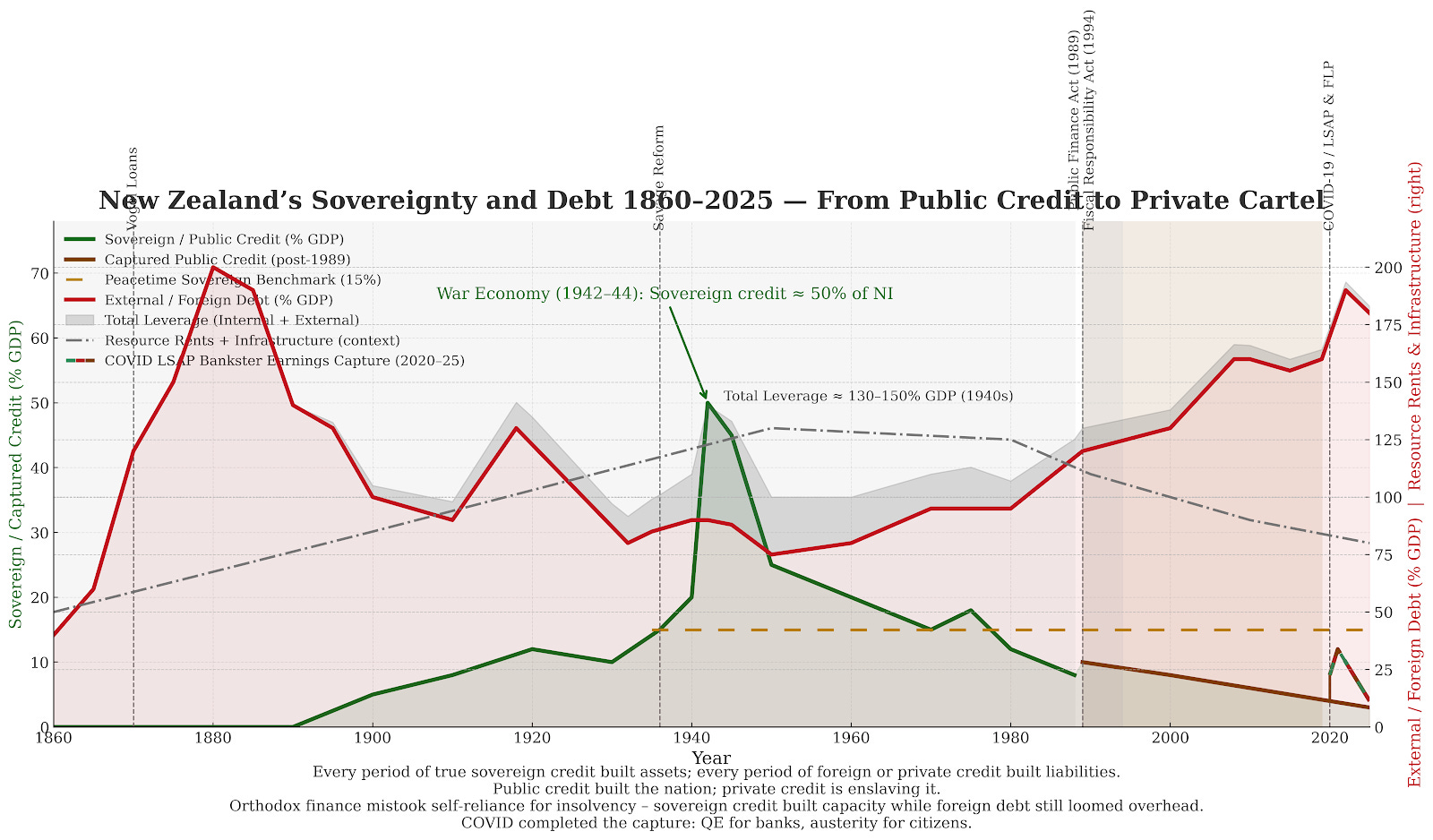
Panel Three — Credit Architecture
Panel Three illustrates the structural evolution of the financial system.
The chart maps three balance-sheet trajectories.
Green line:
Sovereign and public credit.
Brown line:
Residual public credit under the fiscal regime.
Red line:
External liabilities.
Grey shaded area:
Private leverage generated by bank credit creation.
The chart shows a structural shift:
• public development credit declined
• private mortgage credit expanded
• external liabilities increased.
The balance of financial power moved from sovereign institutions toward private mortgage banking.
MODULE XX
Treasury Trap System Loop
Measurement excludes housing credit dynamics
↓
Monetary policy targets CPI
↓
Interest rates adjust price of credit
↓
Private banks dominate credit creation
↓
Collateral incentives favour land
↓
Mortgage lending expands
↓
Housing prices rise
↓
Credit–asset feedback strengthens
↓
Bank funding requirements increase
↓
Offshore funding expands
↓
External liabilities increase
↓
Income outflows increase
↓
Cheap tradable imports suppress CPI
↓
CPI remains stable
↓
Policy perceives inflation under control
↓
System persists.
MODULE XXI
Structural Economic Consequences
The system produces several long-run outcomes.
These include:
rising household leverage
concentration of wealth in housing assets
capital misallocation toward land
diminished sovereign capacity for capital formation
infrastructure underinvestment
increased exposure to external financial flows
potential productivity stagnation.
MODULE XXII
Historical Precedent — Currency Act 1764
The Currency Act of 1764 restricted colonial paper money issuance in British North America.
Colonial economies had previously issued local paper currencies used to finance domestic economic activity.
The Act curtailed these domestic credit mechanisms.
Economic historians link the restriction to:
• credit shortages
• increased private indebtedness
• economic contraction in several colonies.
These financial tensions contributed to political conflict leading toward the American Revolution.
The episode illustrates a broader structural principle:
when domestic economies lose the ability to generate development credit, private debt expansion often replaces public investment.
FINAL SYSTEM LAW
Measurement
↓
Policy Rules
↓
Incentives
↓
Credit Allocation
↓
Economic Structure
↓
National Outcomes.
MODULE XXI
Panel Three Credit Architecture
Panel Three maps the balance-sheet manifestation of the system.
Green line represents sovereign and public credit.
Brown line represents private bank credit.
Red line represents external liabilities.
The rising brown line reflects the displacement of sovereign development credit by mortgage-dominated private credit creation.
Panel Three therefore represents the displacement of the capital constitution of the economy.
MODULE XXII
Constitutional Diagnosis
If institutional design simultaneously:
removes mechanisms for directing sovereign development credit
transfers credit creation authority to private banks
governs monetary policy through a measurement system that excludes housing credit dynamics
discourages public capital formation through accounting rules
allows mortgage-dominated credit allocation
links domestic leverage to external liabilities
then the state’s capacity to steward capital formation and economic development becomes structurally impaired.
MODULE XXIII
Constitutional Question
The central constitutional question is therefore:
whether an institutional architecture that removes sovereign mechanisms for directing capital formation while obscuring the resulting dynamics through measurement systems remains consistent with the fiduciary obligations of democratic governance.
Below is the corrected canonical system map, regenerated to incorporate all hinges, elephants, and pearls identified in this thread and in the critique.
The structure now follows strict mechanical causal order:
sovereign powers → institutional rules → incentives → credit creation → credit allocation → capital formation → economic structure → outcomes
It also explicitly integrates:
Public Finance Act accounting mechanism
financial liberalisation details
collateral advantage of land
credit-asset capitalisation
external funding feedback
income leakage
Panel Three as capital constitution displacement
credit creation vs funding distinction.
This is written to ledger-grade formal constitutional logic.
MODULE XXIV
ASSET TRANSFER VS CAPITAL FORMATION
Capital formation occurs when financial resources create new productive assets.
Examples include:
• infrastructure construction
• new housing supply
• industrial facilities
• energy systems
• technology development.
By contrast, many financial transactions involve the transfer of ownership of existing assets rather than the creation of new productive capacity.
Examples include:
• purchase of existing housing
• purchase of land titles
• financial asset trading.
Mortgage lending frequently finances the purchase of existing housing stock and land titles.
When credit finances asset transfers rather than new construction, financial leverage increases without corresponding increases in productive capacity.
This distinction is critical for understanding the structural effects of mortgage-dominant credit systems.
MODULE XXV
LAND PRICE CAPITALISATION
Land prices reflect the capitalisation of expected future economic benefits associated with land ownership.
These benefits may include:
• rental income
• development rights
• infrastructure access
• expected price appreciation.
When credit availability expands, purchasing power in land markets increases.
Greater purchasing power raises land prices.
Higher land prices increase collateral values.
Higher collateral values support further borrowing.
This process produces a reinforcing feedback mechanism:
credit expansion
→ rising land prices
→ higher collateral values
→ increased borrowing capacity
→ further credit expansion.
MODULE XXVI
CURRENT ACCOUNT AND CREDIT EXPANSION
When domestic credit expansion exceeds domestic savings, banks must obtain additional funding.
Funding sources may include:
• offshore wholesale borrowing
• international capital markets.
External borrowing increases the external liabilities of the banking system.
These liabilities generate future income outflows through:
• interest payments
• dividends
• profit repatriation.
In macroeconomic accounting:
current account deficit
capital inflow from foreign investors.
Mortgage-dominant credit expansion can therefore contribute indirectly to persistent external deficits.
MODULE XXVII
CONSTITUTIONAL BREACH TEST
Governments exercising sovereign economic powers must satisfy three duties.
Fiduciary Duty
The exercise of public authority must advance the long-term prosperity and stability of the nation.
Duty of Care
Institutional design must consider foreseeable systemic consequences.
Honest Weights and Measures
Measurement systems guiding policy must accurately represent the economic phenomena they regulate.
A constitutional failure may occur when all of the following conditions are present:
measurement systems systematically omit dominant economic pressures affecting households or capital formation
policy institutions rely heavily on those measurement systems
institutional arrangements predictably redirect credit creation toward asset inflation rather than productive investment
governments continue to represent the resulting outcomes as successful policy performance.
Under such conditions the alignment between sovereign authority and public purpose may be materially weakened.
MODULE XXVIII
THE BROWN LINE — CORRECTED INTERPRETATION
Panel Three illustrates the balance-sheet transformation of New Zealand’s financial system.
Green Line
Sovereign and public credit used to finance national development.
Brown Line
Residual public credit under post-reform fiscal constraints.
Grey Area
Private leverage generated primarily through mortgage credit.
Red Line
External financial liabilities.
The rising brown/grey structure reflects the replacement of sovereign development credit with mortgage-dominant private credit creation.
This represents a structural transfer of capital formation power:
from public development institutions
to private mortgage banking.
MODULE XXIX
INSTITUTIONAL RESTORATION QUESTION
If
• sovereign development-credit institutions no longer exist
• fiscal accounting discourages sovereign capital investment
• commercial banks allocate most new credit toward property collateral
• inflation measurement obscures housing-credit dynamics
then the institutional mechanism responsible for directing capital toward national development becomes unclear.
This raises a fundamental governance question:
Which institutions are responsible for directing capital formation toward the long-term productive capacity of the nation?
MODULE XXX
SYSTEM REFORM PRINCIPLE
Institutional reform does not require the elimination of private finance.
Rather, reform concerns the balance of credit architectures.
A resilient economic constitution typically includes multiple channels of capital finance, including:
• private banking
• sovereign public investment
• development finance institutions
• capital markets
• foreign investment.
When one channel dominates capital allocation, structural distortions may emerge.
The challenge of economic governance is therefore to design institutions that maintain a balanced capital-formation system.
TBLR CORE LEDGER
REFORM CONSTITUTION MODULE v3.0
Restoration of Sovereign Capital Formation and Measurement Integrity
MODULE XLII
Purpose of Reform
The Treasury Trap describes an institutional condition in which the architecture of measurement, credit creation, and fiscal governance directs financial resources toward asset inflation rather than productive capital formation.
Under this condition:
• sovereign development credit disappears
• private mortgage credit becomes dominant
• housing leverage expands
• infrastructure investment weakens
• external financial exposure increases.
The purpose of reform is to restore sovereign institutional capacity to guide capital formation toward long-term national development.
Reform does not eliminate private finance.
Reform restores a balanced financial constitution in which multiple credit systems operate simultaneously.
MODULE XLIII
First Principle of Economic Governance
Credit creation determines investment.
Investment determines the structure of the economy.
Economic governance therefore requires institutions capable of influencing the allocation of credit.
Where credit creation becomes concentrated in a single institutional channel, the structure of the economy will follow the incentives of that channel.
MODULE XLIV
Sovereign Economic Dashboard
Economic governance shall be guided by a Sovereign Economic Dashboard.
The dashboard shall measure national performance across five domains.
Measurement Integrity
Indicators include:
• CPI inflation
• household living cost indices
• food price dynamics
• housing price dynamics
• tradables inflation
• non-tradables inflation.
Credit Allocation
Indicators include:
• mortgage credit growth
• business credit growth
• sectoral credit distribution.
Capital Formation
Indicators include:
• infrastructure investment
• housing construction
• industrial investment.
External Balance
Indicators include:
• current account balance
• net international investment position
• foreign funding exposure.
Institutional Integrity
Indicators include:
• transparency compliance
• conflict-of-interest reporting
• institutional independence.
Dashboard data shall be:
• published annually
• audited by the Auditor-General
• publicly accessible.
Persistent deterioration shall trigger mandatory parliamentary review.
MODULE XLV
Honest Weights and Measures
Economic governance depends on accurate measurement.
Legal traditions requiring honest weights and measures appear in:
• ancient Near Eastern law
• biblical law
• medieval market regulation.
Modern economic governance inherits this principle.
Measurement systems must represent the dominant economic forces affecting households and capital formation.
Where measurement excludes key economic pressures, policy decisions become structurally distorted.
MODULE XLVI
Measurement Integrity Institutions
A measurement integrity authority shall review national economic indicators used in policy.
Responsibilities include:
• auditing inflation metrics
• reviewing cost-of-living indicators
• identifying measurement distortions.
The authority shall report annually to Parliament.
MODULE XLVII
Restoration of Sovereign Development Credit
The financial system shall include institutions capable of directing credit toward national development.
Development finance institutions shall provide long-term credit for:
• infrastructure
• energy systems
• housing construction
• industrial development.
These institutions restore sovereign influence over capital formation.
MODULE XLVIII
Hybrid Credit Architecture
A resilient financial system contains multiple channels of credit creation.
These include:
Private bank credit
Sovereign development credit
Public investment
International capital.
Private banks remain central to the financial system.
However private mortgage lending shall not remain the dominant mechanism of capital formation.
Institutional reforms shall therefore ensure the continued existence of sovereign development credit channels.
MODULE XLIX
Housing Capital Formation Reform
Mortgage credit frequently finances transfers of existing housing.
Housing finance reform shall direct credit toward:
• new housing construction
• supporting infrastructure.
This reduces the tendency of mortgage credit expansion to inflate land prices without increasing supply.
MODULE L
Fiscal Capital Accounting
Public investment produces long-lived assets.
Fiscal reporting shall distinguish between:
• consumption expenditure
• capital formation.
Capital investment reporting shall include:
• asset creation
• infrastructure value
• long-term economic return.
This distinction prevents productive investment from being misrepresented as fiscal deterioration.
MODULE LI
External Balance Defence
Domestic credit expansion financed through foreign borrowing increases national external liabilities.
External balance monitoring shall therefore track:
• foreign bank funding exposure
• external debt levels
• international investment position.
Persistent deterioration shall trigger policy review.
MODULE LII
Panel Three
Panel Three illustrates the balance-sheet evolution of the New Zealand economy.
Green line
Sovereign development credit.
Brown line
Constrained sovereign credit following reform.
Grey structure
Private mortgage leverage.
Red line
External liabilities.
Panel Three demonstrates the structural transfer of capital formation authority from public institutions to mortgage-dominant private banking.
MODULE LIII
Historical Precedent
Historical examples demonstrate the consequences of restricting domestic credit creation.
The Currency Act 1764 restricted the American colonies from issuing paper currency.
Economic historians link this restriction to:
• credit shortages
• rising private debt
• economic stagnation.
These pressures contributed to tensions preceding the American Revolution.
The historical lesson is that restricting domestic development credit can shift financial leverage toward private debt.
MODULE LIV
National Dividend
A National Dividend distributes a share of national productivity to citizens.
Funding sources may include:
• sovereign investment returns
• public asset income
• resource rents.
The dividend strengthens the link between citizens and the productive capacity of the national economy.
Final Reform Principle
A resilient economic constitution requires:
• accurate measurement
• diversified credit systems
• sovereign capital formation institutions.
When these conditions are present, financial systems can support both private enterprise and national development.
TBLR SYSTEM MAP (CANONICAL)
Constitutional Architecture of Credit, Measurement, and Capital Formation
LAYER 1 — SOVEREIGN ECONOMIC POWERS
Modern states exercise public authority over several core economic instruments.
These include:
control of currency and monetary systems
regulation of banking and credit creation
authority over taxation and sovereign borrowing
determination of national accounting frameworks.
These powers form the economic constitution of the state.
They determine the institutional rules governing credit, investment, and capital formation.
LAYER 2 — INSTITUTIONAL RULES
Institutional rules determine the operating framework of the financial system.
Four domains are critical.
financial regulation
fiscal accounting rules
monetary policy mandates
economic measurement systems.
These rules shape the incentives faced by financial actors.
LAYER 3 — REFORM ARCHITECTURE
During the late twentieth century reforms, these institutional rules changed simultaneously.
Financial Liberalisation
Key changes included:
• removal of interest-rate controls
• removal of credit ceilings
• removal of exchange controls.
These reforms allowed commercial banks to expand balance sheets and create credit more freely.
Withdrawal of Sovereign Development Credit
Public development-credit institutions were dismantled or allowed to disappear.
Examples included:
• State Advances lending systems
• Housing Corporation mortgage lending
• Development Finance Corporation.
These institutions previously directed credit toward housing construction, infrastructure, and industrial development.
Their removal reduced the state’s institutional capacity to direct capital formation.
Fiscal Accounting Transformation
The Public Finance Act introduced accrual accounting.
Under accrual accounting:
capital investment increases recorded Crown liabilities.
Consequently:
public capital formation appears as government debt.
When fiscal policy targets debt ratios, this accounting treatment creates a political disincentive for sovereign investment.
Monetary Policy Narrowing
The mandate of the
Reserve Bank of New Zealand
shifted toward CPI inflation targeting.
The primary instrument became the Official Cash Rate.
Interest-rate policy governs the price of credit.
It does not determine credit allocation.
Measurement Architecture
Inflation targeting relies primarily on the Consumer Price Index.
Institution:
Statistics New Zealand
CPI measures consumption prices rather than asset prices or financing costs.
CPI excludes:
• land prices
• house purchase prices
• mortgage principal repayments
• mortgage interest payments.
Housing appears mainly through rents and maintenance expenditures.
LAYER 4 — INCENTIVES
Institutional rules create the incentives governing financial behaviour.
Two mechanisms dominate.
Collateral Incentives
Banks allocate credit based on collateral security and risk.
Land possesses several characteristics favouring its use as collateral.
• immobility
• legally secure title
• durability
• historically appreciating value.
These properties reduce perceived lending risk.
Therefore bank credit allocation gravitates toward land-secured lending.
Measurement Incentives
Because CPI excludes housing credit dynamics and averages domestic prices against imported goods, policy feedback from inflation targeting does not fully capture housing-credit inflation.
This reduces policy response to mortgage-driven asset inflation.
LAYER 5 — CREDIT CREATION
Commercial banks create deposits when issuing loans.
In modern banking systems this mechanism constitutes the dominant form of money creation.
After the withdrawal of sovereign development-credit institutions, banks became the primary creators of new domestic credit.
LAYER 6 — CREDIT ALLOCATION
Bank lending decisions follow collateral incentives.
Reserve Bank lending statistics indicate approximately:
60–65 percent residential mortgage lending
25–30 percent business lending.
However significant portions of business lending are also secured against property, including:
• agricultural land mortgages
• commercial property loans
• development finance.
Consequently the banking system has substantial exposure to property collateral.
LAYER 7 — CREDIT–ASSET CAPITALISATION
Mortgage credit increases purchasing power within land markets.
Land prices rise when credit supply increases.
Higher land prices capitalise expected rents and future appreciation into asset values.
This produces a feedback mechanism:
credit expansion → higher land prices → increased borrowing capacity → further credit expansion.
LAYER 8 — CREDIT CREATION VS FUNDING
Credit creation and bank funding are distinct processes.
Banks create credit when lending.
Balance sheet funding may originate from:
• domestic deposits
• offshore wholesale borrowing.
Mortgage credit expansion increases bank funding requirements.
LAYER 9 — EXTERNAL FUNDING FEEDBACK
New Zealand banks rely significantly on offshore wholesale funding.
Evidence appears in:
• BIS cross-border banking statistics
• Reserve Bank financial stability reports.
Mortgage credit growth increases offshore borrowing.
Offshore funding availability also enables further domestic credit expansion.
This creates a bidirectional relationship between credit growth and external funding.
LAYER 10 — EXTERNAL LIABILITIES AND INCOME FLOWS
Offshore funding increases external liabilities.
External liabilities generate income outflows through:
• interest payments
• profit repatriation
• foreign investment income.
New Zealand records persistent net primary income deficits, commonly approximating five to seven percent of GDP.
LAYER 11 — POLICY FEEDBACK FAILURE
Because CPI excludes housing-credit dynamics, rising housing prices and mortgage leverage may occur without corresponding CPI inflation.
Monetary policy therefore receives incomplete information about credit-driven inflation.
Interest-rate adjustments affect borrowing costs but do not change structural credit allocation.
LAYER 12 — CAPITAL FORMATION EFFECT
Credit allocation determines capital formation.
Mortgage lending primarily finances the transfer of ownership of existing land assets rather than the creation of new productive capital.
Consequently:
credit flows toward land ownership rather than infrastructure, industrial investment, or export capacity.
LAYER 13 — STRUCTURAL ECONOMIC OUTCOMES
The system produces several long-term structural outcomes.
rising household leverage
housing-asset wealth concentration
capital misallocation toward land
reduced sovereign capacity for capital formation
infrastructure underinvestment
increased external financial exposure
potential productivity stagnation.
LAYER 14 — PANEL THREE REPRESENTATION
Panel Three visualises the balance-sheet consequences of the system.
Green line:
sovereign and public credit.
Brown line:
private bank credit.
Red line:
external liabilities.
The rising brown line reflects the displacement of sovereign development credit by mortgage-dominated private credit creation.
Panel Three therefore illustrates the displacement of the capital constitution of the economy.
LAYER 15 — CONSTITUTIONAL DIAGNOSIS
If institutional design simultaneously:
• removes sovereign mechanisms for directing capital formation
• transfers credit creation authority to private banks
• governs monetary policy using measurement systems that exclude housing-credit dynamics
• discourages public capital investment through fiscal accounting rules
• allows mortgage-dominated credit allocation
• links domestic leverage to external liabilities
then the state’s ability to steward national capital formation becomes structurally impaired.
FINAL CONSTITUTIONAL QUESTION
Is an economic architecture that transfers the practical power of credit creation and allocation away from sovereign institutions, while obscuring its consequences through measurement systems, consistent with the fiduciary responsibilities of democratic governance?
TBLR CORE LEDGER
MEASUREMENT CONSTITUTION MODULE
I. GOVERNING PRINCIPLE
Economic measurement systems are not neutral descriptive tools.
They perform three constitutional functions.
They define what counts as an economic problem.
They determine when policy institutions respond.
They influence how burdens and benefits are distributed across society.
Therefore:
measurement systems form part of the constitutional architecture of economic governance.
II. DEFINITION — MEASUREMENT CONSTITUTION
The measurement constitution is the set of official indicators, accounting rules, and statistical classifications that determine how economic reality is recognised by policy institutions.
It includes:
• inflation measures
• fiscal measures
• debt measures
• balance-sheet classifications
• cost-of-living measures
• sectoral lending classifications.
These measures shape the operation of:
• central banking
• fiscal policy
• regulatory policy
• public investment decisions.
III. CONSTITUTIONAL STATUS OF MEASUREMENT
A measurement regime has constitutional significance when it performs any of the following functions:
triggers policy responses
constrains or enables public action
defines official economic success or failure
allocates burdens across sectors or social groups.
By this standard, measurement systems such as CPI, HLPI, debt ratios, and public-balance-sheet rules are not merely statistical.
They are governing instruments.
IV. HONEST WEIGHTS AND MEASURES
The principle of honest weights and measures is one of the oldest doctrines in economic governance.
It appears across:
• ancient Near Eastern trade systems
• biblical law
• classical legal traditions
• Roman market regulation
• medieval and early modern European law.
Its core principle is simple:
if the measure is false, the governance built upon it is distorted.
In modern economic systems, the analogue of weights and measures is:
• inflation indices
• debt metrics
• accounting standards
• official price classifications.
Therefore:
If official measurement systems omit the dominant drivers of economic pressure, governance fails the honest-weights principle.
V. CPI AS A CONSTITUTIONAL MEASURE
In New Zealand the Consumer Price Index is the principal measure used for inflation targeting.
Because it is used to guide monetary policy, CPI performs a constitutional role.
It influences:
• official perceptions of inflation
• Reserve Bank responses
• wage and benefit expectations
• political narratives about economic stability.
Therefore CPI is not merely descriptive.
It is an operative constitutional metric.
VI. CPI SCOPE AND LIMITS
CPI is designed as a consumer price index.
It measures price changes in a basket of household consumption items.
It does not directly measure:
• land prices
• house purchase prices
• mortgage principal repayments
• mortgage interest payments.
Housing enters CPI mainly through:
• rents
• maintenance
• insurance
• local government rates.
Therefore CPI does not directly capture the full cost structure of a mortgage-credit-driven housing economy.
VII. CPI AVERAGING STRUCTURE
CPI aggregates very different categories of prices into a single average.
These include:
Tradable goods
• electronics
• clothing
• appliances
• imported manufactures
Essential domestic costs
• food
• rent and housing-related costs
• insurance
• utilities
• domestic services
• transport-related essentials
Administrative and regulated costs
• local government rates
• network utility charges
• compliance-driven service costs
• infrastructure-related charges
• licensing and regulated fees embedded in household expenses
Because CPI is an average, falling tradable goods prices can offset rising essential and administrative domestic costs.
Therefore CPI can remain relatively stable while lived household cost pressure rises.
VIII. DUAL MASKING MECHANISM
The New Zealand measurement system contains two distinct masking effects.
A. Averaging Mask
Rising essential domestic costs are averaged against cheaper tradable goods.
This can suppress headline CPI even while household essentials become more expensive.
B. Exclusion Mask
Key housing-credit costs are not directly included in headline CPI.
These include:
• land prices
• mortgage principal
• mortgage interest.
This means the dominant pressures in a credit-driven housing system can remain structurally underrepresented in the policy index.
IX. CONSEQUENCE — POLICY INFLATION VS LIVED INFLATION
Because of the averaging mask and exclusion mask, there can be a divergence between:
Policy inflation
Inflation as measured by CPI and used by monetary authorities.
Lived inflation
The actual increase in household financial pressure experienced through:
• food
• rent or housing-related costs
• insurance
• utilities
• administrative charges
• debt-servicing pressure in household budgets.
This divergence weakens policy feedback.
The state can record inflation as “under control” while households experience rising economic stress.
X. HLPI AS A CORRECTIVE MEASURE
The Household Living-Cost Price Index provides a different perspective.
HLPI tracks the cost pressures faced by households more directly, including mortgage-interest effects for relevant household groups.
Therefore HLPI is closer than CPI to lived inflation for leveraged households.
This does not make HLPI “better” in every context.
It means that CPI and HLPI serve different constitutional functions.
CPI is a macro policy index.
HLPI is a household-cost index.
Failure to distinguish them creates analytical confusion.
XI. MEASUREMENT AND MONETARY POLICY
The Reserve Bank adjusts the Official Cash Rate in response to inflation signals.
If the inflation signal is structurally incomplete, then monetary policy operates with incomplete information.
Therefore:
If CPI excludes key housing-credit dynamics while the banking system is dominated by mortgage lending, monetary policy can systematically underreact to the dominant inflationary mechanism in the economy.
This is a structural policy problem, not a one-off error.
XII. MEASUREMENT AND DISTRIBUTION
Measurement regimes are also distributive.
If policy is guided by an index that underweights or excludes the dominant pressures on some households, then policy will tend to privilege the conditions of households less exposed to those pressures.
In a mortgage-credit-driven economy this means:
households exposed to food, housing, insurance, utilities, rates, and debt-service stress may experience higher lived inflation than headline CPI suggests.
Therefore measurement systems affect distributional justice.
XIII. MEASUREMENT AND FISCAL GOVERNANCE
The measurement constitution is not limited to CPI.
It also includes fiscal accounting metrics such as:
• debt-to-GDP ratios
• liability measures
• accrual accounting categories.
When public capital investment appears primarily through liability measures, fiscal debate can treat investment as debt rather than as capital formation.
This links measurement directly to public-investment capacity.
Thus:
the measurement constitution governs both monetary and fiscal action.
XIV. MEASUREMENT FAILURE TEST
A measurement regime fails constitutionally when all of the following are present:
the metric is used to trigger policy
the metric excludes dominant economic pressures
policy institutions rely heavily on that metric
the excluded pressures materially affect households or capital formation.
Under those conditions, measurement failure becomes a constitutional problem rather than a technical issue.
XV. THE NEW ZEALAND CASE
In the New Zealand Treasury Trap architecture:
• CPI is the principal inflation metric
• OCR policy targets CPI
• private banks dominate credit creation
• mortgage lending dominates bank lending
• housing-credit costs are not fully represented in CPI
• essential and administrative domestic costs can be diluted by cheaper tradables.
Therefore the measurement regime can register stability while the underlying economic structure becomes more leveraged, more property-dominated, and more burdensome for households.
XVI. FORMAL PROPOSITION
If
monetary policy is governed primarily by CPI
CPI excludes land and mortgage-credit dynamics
CPI averages rising domestic essentials against cheaper tradables
banks allocate most credit toward housing collateral
then
headline inflation stability does not imply structural economic stability.
XVII. CONSTITUTIONAL CONCLUSION
Measurement is not a neutral mirror of the economy.
Measurement governs the perception of the economy, and perception governs institutional response.
Therefore:
the measurement constitution is part of the economic constitution.
If the measurement constitution fails to register the dominant forces shaping household burden and capital formation, then the state’s fiduciary duty, duty of care, and obligation to maintain honest weights and measures are all placed in question.
XVIII. LEDGER USE RULE
Whenever a future argument refers to inflation, cost of living, or monetary stability, it must distinguish:
• CPI
• HLPI
• tradable prices
• essential domestic costs
• administrative and regulated costs
• excluded housing-credit costs.
Failure to distinguish these constitutes a measurement smudge.
TBLR DEFINITIONS LOCK v3
Canonical Economic Terms for Constitutional Analysis
1 — Sovereign Credit Creation
Definition
Sovereign credit creation is the expansion of purchasing power through balance-sheet operations conducted by public monetary or financial institutions under public authority.
Mechanisms may include:
• central bank credit extended to the state
• lending by publicly owned financial institutions
• credit issued through development finance agencies.
Functional property
Sovereign credit creation increases financial assets within the domestic economy without requiring prior private savings.
Allocation decisions are governed by public institutions rather than private lenders.
2 — Sovereign Borrowing
Definition
Sovereign borrowing occurs when a government issues financial securities and receives funds from investors.
Typical instruments include government bonds.
Mechanism
Borrowing transfers existing financial resources from lenders to the state.
Borrowing does not itself create new money unless associated with banking or central bank operations.
3 — Public Development Credit
Definition
Public development credit refers to credit issued or directed through publicly owned financial institutions for the purpose of supporting national development.
Examples historically include:
• state housing finance programmes
• public agricultural lending systems
• national development banks.
Economic function
Public development credit directs financing toward capital formation in areas such as:
• infrastructure
• housing construction
• industrial development
• strategic national capabilities.
4 — Private Bank Credit Creation
Definition
Commercial banks create deposits when issuing loans.
The lending process simultaneously creates:
• a loan asset on the bank balance sheet
• a deposit liability representing newly created money.
System role
In modern financial systems private banks are the dominant creators of new credit.
The sectors receiving bank credit therefore shape the pattern of investment within the economy.
5 — Bank Funding
Definition
Bank funding refers to the liabilities used to finance bank balance sheets.
These include:
• customer deposits
• wholesale borrowing
• offshore funding
• bank capital instruments.
Distinction
Credit creation occurs when loans are issued.
Funding refers to the sources supporting the bank’s balance sheet.
These are analytically separate processes.
6 — Credit Allocation
Definition
Credit allocation refers to the distribution of newly created credit across sectors of the economy.
Allocation may occur through:
• private lending decisions
• regulatory guidance
• publicly directed development credit programmes.
Economic importance
Credit allocation determines which sectors receive financing and therefore shapes the structure of economic activity.
7 — Credit Direction
Definition
Credit direction refers to institutional mechanisms that guide credit allocation toward specific sectors.
Examples include:
• development banks
• state-directed lending programmes
• sectoral lending quotas
• government-supported industrial finance schemes.
8 — Capital Formation
Definition
Capital formation is the creation of new productive assets that increase the economy’s capacity to produce goods and services.
Examples include:
• infrastructure construction
• industrial machinery
• energy generation systems
• transport networks
• technological research capability.
9 — Asset Transfer vs Capital Formation
Definition
Transactions involving existing assets may transfer ownership without creating new productive capacity.
Examples include:
• purchase of existing land
• purchase of existing housing stock.
Such transactions primarily redistribute asset ownership rather than create new capital.
10 — Capital Misallocation
Definition
Capital misallocation occurs when credit flows disproportionately toward activities that do not increase productive capacity.
Examples include:
• speculative land purchases
• financial asset speculation
• leverage applied primarily to asset price inflation.
Persistent capital misallocation can reduce long-term economic growth.
11 — Land Price Capitalisation
Definition
Land price capitalisation is the process by which expected future income from land ownership becomes incorporated into current land prices.
Mechanism
Expanded credit availability increases purchasing power in land markets.
Higher purchasing power raises land prices.
Rising land prices increase collateral values and borrowing capacity.
This produces a reinforcing cycle:
credit expansion → higher land prices → increased borrowing → further credit expansion.
12 — Mortgage Credit Expansion
Definition
Mortgage credit expansion refers to the growth of bank lending secured against residential or commercial property.
Mortgage lending increases purchasing power in land markets and contributes to asset price inflation.
13 — Mortgage–Funding Transmission
Definition
Mortgage-funding transmission refers to the mechanism through which domestic mortgage lending leads to offshore borrowing by banks.
Sequence
mortgage lending expands
→ bank balance sheets grow
→ banks seek additional funding
→ offshore wholesale borrowing increases
→ external liabilities rise.
14 — Household Leverage
Definition
Household leverage refers to the ratio of household debt to household income or assets.
Mortgage borrowing typically constitutes the largest component of household leverage.
15 — External Liabilities
Definition
External liabilities represent financial obligations owed by domestic residents to foreign investors or lenders.
Sources include:
• offshore borrowing
• foreign ownership of domestic assets.
External liabilities generate future income outflows.
16 — Net Primary Income Balance
Definition
Net primary income measures income flows between residents and non-residents arising from investment and employment.
A deficit occurs when payments to foreign investors exceed income received from overseas assets.
Typical components include:
• interest payments
• dividend payments
• profit repatriation.
17 — Inflation Measurement
Definition
Inflation measurement refers to statistical indicators used to track price changes across the economy.
In New Zealand the primary indicator is the Consumer Price Index produced by
Statistics New Zealand.
Measurement scope
CPI measures consumer goods and services.
It does not directly measure:
• land prices
• asset prices
• mortgage principal payments
• mortgage interest costs.
18 — Monetary Policy
Definition
Monetary policy refers to central bank actions intended to influence credit conditions within the economy.
In New Zealand the central bank is the
Reserve Bank of New Zealand.
The primary instrument is the Official Cash Rate.
Policy scope
Interest-rate policy primarily affects the price of credit.
Credit allocation decisions remain largely determined by lending institutions.
19 — The Treasury Trap
Definition
The Treasury Trap describes a structural condition in which:
• sovereign mechanisms for directing development credit are removed
• private banks dominate credit creation
• credit allocation gravitates toward property collateral
• inflation measurement excludes housing-credit dynamics
• fiscal accounting discourages sovereign investment.
Under these conditions credit expansion primarily inflates asset prices rather than productive capital formation.
20 — Panel Three
Definition
Panel Three is a balance-sheet representation of the credit architecture of the economy.
It distinguishes three financial trajectories:
Green line — sovereign and public credit
Brown line — residual public credit under post-reform fiscal constraints
Red line — external or foreign liabilities.
Interpretation
Panel Three illustrates the collapse of sovereign development credit and the simultaneous rise of external financial obligations.
The chart visualises the shift in the locus of leverage from public balance sheets toward private and external balance sheets.
Closing Statement
The definitions in this module establish precise distinctions between:
• sovereign credit creation
• sovereign borrowing
• private bank credit creation
• credit allocation
• capital formation
• asset price inflation.
These distinctions prevent analytical confusion and protect the integrity of the constitutional analysis.
21 — Official Cash Rate (OCR)
Definition
The Official Cash Rate is the policy interest rate set by the
Reserve Bank of New Zealand.
It represents the rate at which banks can borrow or deposit settlement cash with the central bank overnight.
Function
The OCR influences short-term interest rates throughout the financial system.
Changes in the OCR affect:
• mortgage interest rates
• business lending rates
• deposit rates.
Policy scope
The OCR primarily influences the price of credit.
It does not directly determine:
• the quantity of credit created by banks
• the allocation of credit across sectors of the economy.
22 — Consumer Price Index (CPI)
Definition
The Consumer Price Index is the primary inflation indicator produced by
Statistics New Zealand.
It measures the average price change of a basket of consumer goods and services purchased by households.
CPI measures consumer price averages, not the structural cost dynamics of housing, credit, and domestic services.
Coverage
CPI measures prices of items such as:
• food
• transport
• energy
• rent
• household goods
• services.
Exclusions
CPI does not directly measure:
• land prices
• house purchase prices
• mortgage principal repayments
• mortgage interest payments.
Implication
Because housing credit dynamics are not fully represented in CPI, large increases in mortgage borrowing and house prices may occur without equivalent increases in measured CPI inflation.
Structural Limitation of CPI-Based Inflation Targeting
Inflation targeting based primarily on CPI has several structural limitations.
CPI does not fully capture several important economic dynamics.
These include:
• asset price inflation, including land and housing prices
• credit allocation patterns within the financial system
• land price capitalisation driven by mortgage credit expansion
• household financing costs such as mortgage principal payments
• divergences between domestic cost pressures and imported goods prices.
Tradables Averaging Mechanism
CPI aggregates price movements across both domestically produced goods and imported tradable goods.
When prices of imported manufactured goods fall — for example electronics, appliances, or clothing — these declines can offset rising prices of domestic essentials.
Examples of domestic costs that may rise include:
• housing
• construction
• insurance
• local services
• utilities.
As a result, CPI may remain relatively stable even while the cost of essential domestic goods and services increases.
Policy Implication
Because CPI averages these components together, inflation targeting based solely on CPI may provide incomplete feedback regarding structural price pressures within the domestic economy.
Why This Matters
This mechanism explains how the following can occur simultaneously:
stable CPI
+
rising housing costs
+
rising mortgage debt
+
rising household cost pressures
The result is a divergence between:
policy inflation
vs
lived inflation
which weakens policy feedback.
23 — Household Living-Cost Price Index (HLPI)
Definition
The Household Living-Cost Price Index is a statistical measure produced by
Statistics New Zealand.
HLPI estimates the change in the cost of living experienced by households by tracking changes in prices of items households actually pay.
Coverage
HLPI includes components such as:
• mortgage interest payments
• rent
• insurance
• household expenses.
Difference from CPI
HLPI reflects the cost pressures faced by households, whereas CPI measures consumer price inflation in the economy.
Because mortgage interest is included in HLPI but excluded from CPI, household living costs may rise faster than CPI during periods of high interest rates.
24 — Inflation Targeting
Definition
Inflation targeting is the monetary policy framework under which the central bank adjusts the Official Cash Rate to maintain CPI inflation within a specified range.
In New Zealand this framework was established through amendments to the Reserve Bank Act.
Operational principle
When CPI inflation rises above the target range, the central bank raises the OCR.
When CPI inflation falls below the target range, the central bank may lower the OCR.
Structural limitation
Inflation targeting based solely on CPI does not directly account for:
• asset price inflation
• credit allocation patterns
• land price dynamics.
25 — Policy Inflation vs Lived Inflation
Definition
Policy inflation refers to inflation measured by official indicators used for monetary policy, primarily CPI.
Lived inflation refers to the change in actual cost pressures experienced by households.
Measurement divergence
Policy inflation and lived inflation may diverge when:
• asset prices rise rapidly
• housing costs increase
• credit expansion affects asset markets rather than consumer goods.
Implication
A divergence between CPI and household cost pressures can weaken economic feedback within monetary policy.
Integration with the Treasury Trap
These definitions complete the measurement architecture of the system.
The Treasury Trap depends on three interacting elements:
CPI-based inflation targeting
OCR-based interest-rate policy
mortgage-dominated credit allocation.
Together they allow:
stable CPI
+ rising mortgage credit
+ rising house prices
+ rising household leverage
To co-exist
TRADABLES / NON-TRADABLES INFLATION
26 — Tradable Goods
Definition
Tradable goods are goods that are internationally traded and whose prices are strongly influenced by global markets.
Examples include:
• electronics
• clothing
• vehicles
• imported manufactured goods
• many household appliances.
Price dynamics
Prices of tradable goods are often influenced by:
• global supply chains
• exchange rates
• international competition
• technological improvements.
In many advanced economies, globalisation and manufacturing productivity have caused the prices of many tradable goods to decline over time.
27 — Non-Tradable Goods and Services
Definition
Non-tradable goods and services are items that must be produced and consumed domestically and are not easily traded internationally.
Examples include:
• housing
• construction
• local services
• utilities
• domestic transport
• insurance
• many professional services.
Price dynamics
Prices of non-tradable goods are influenced primarily by domestic conditions such as:
• wages
• land costs
• regulation
• local demand.
Non-tradable prices often rise faster than tradable prices during periods of domestic credit expansion.
28 — Tradables Inflation
Definition
Tradables inflation refers to price changes in internationally traded goods.
In periods of global manufacturing expansion or technological improvement, tradables inflation may be low or negative.
29 — Non-Tradables Inflation
Definition
Non-tradables inflation refers to price changes in goods and services produced within the domestic economy.
Non-tradables inflation is often driven by:
• housing costs
• construction costs
• labour costs
• domestic credit conditions.
30 — CPI Averaging Effect
Definition
The CPI averaging effect occurs when price declines in tradable goods offset price increases in non-tradable goods within the CPI basket.
Because CPI aggregates both categories, falling prices for imported goods can partially mask rising costs in domestic essentials.
falling tradables prices
+
rising non-tradables prices
=
moderate CPI inflation
31 — Structural Inflation Masking
Definition
Structural inflation masking occurs when CPI stability obscures significant increases in key domestic costs such as housing, insurance, and local services.
This phenomenon can occur when:
• tradable goods prices fall due to global competition
• non-tradable goods prices rise due to domestic credit expansion.
32 — Policy Implication
When monetary policy targets CPI alone, structural inflation masking may occur.
Under such conditions:
CPI stability
≠
stable domestic cost structure
This can weaken policy feedback and allow credit-driven asset inflation to persist.
Integration with the Treasury Trap
These definitions complete the measurement architecture of the system.
The Treasury Trap depends on the interaction of three mechanisms:
CPI averaging
+
mortgage-driven credit expansion
+
land price capitalisation
Together they allow
stable CPI
+
rising housing costs
+
rising household leverage
to coexist
Good. Here is the rebuilt Evidence Module, with every line classified as:
A — Officially verified
B — Analytical inference from official sources
C — Requires user-supplied source or tighter documentary proof before canonical use
This is the version that should protect the ledger.
TBLR EVIDENCE MODULE v2
Source Integrity Classification
1. Bank lending is housing-dominant
Status: A — Officially verified
The correct official source is the Reserve Bank’s Registered banks and non-bank lending institutions: Sector lending (C5) page and associated monthly summary tables. Those data support the claim that housing lending is the largest lending category and materially exceeds business lending. For August 2025, the RBNZ summary shows housing lending stock at $382.5b and business lending at $137.9b.
Canonical ledger wording
Reserve Bank sector-lending data show that housing is the largest category of bank lending in New Zealand and materially exceeds business lending.
Do not overstate without date-specific calculation
Avoid locking a timeless percentage unless it is calculated for the exact period being discussed.
2. “About 60–65% of bank lending is housing”
Status: B — Analytical inference from official sources
This is a reasonable shorthand over many periods, but it should not be treated as the canonical form unless tied to a specific date and calculation from the RBNZ tables. The safer approach is to cite the stock values or calculate the share for the selected month.
Canonical ledger wording
Housing lending is the dominant category in RBNZ sector-lending data; exact shares should be calculated from the period-specific table being cited.
3. A large share of business lending is property-secured
Status: C — Requires tighter source
This may be true in substance, given agriculture, commercial property, and development exposures, but I do not currently have a single checked official source in this thread that proves the stronger claim at the level required for the ledger.
Canonical ledger wording
Business lending includes significant property-linked exposures, but the exact share requires a tighter official source or the user’s supplied hardcopy evidence before canonical use.
4. CPI does not directly include mortgage interest in headline CPI
Status: A — Officially verified
Stats NZ’s housing-cost methodology and CPI review material support the distinction between CPI and HLPIs and show that mortgage-interest costs are treated differently from headline CPI. Stats NZ explicitly explains that HLPIs measure owner-occupied housing through mortgage interest payments, while CPI uses a different owner-occupied housing treatment.
Canonical ledger wording
Headline CPI does not directly include mortgage-interest costs in the way HLPIs do; Stats NZ measures owner-occupied housing differently in CPI and HLPIs.
5. CPI excludes land prices
Status: A — Officially verified in practical treatment
Stats NZ’s housing-cost methodology makes clear that CPI is an acquisitions-based consumer price measure and does not treat land-price inflation as part of headline consumer inflation. The housing-cost treatment differs from house-price measures and HLPIs.
Canonical ledger wording
CPI is not a land-price index and does not directly measure land-price inflation.
6. CPI excludes mortgage principal
Status: B — Analytical inference from official sources
Stats NZ’s framework supports this, because CPI is an acquisitions-based consumption measure, not a debt-repayment measure. But the safest canonical wording is not “CPI excludes mortgage principal” in isolation; it is that CPI is not designed to measure financing flows or debt amortisation.
Canonical ledger wording
CPI is an acquisitions-based consumption measure and is not designed to measure mortgage repayment flows such as principal amortisation.
7. CPI can remain stable while housing-credit pressures rise
Status: B — Analytical inference from official sources
This follows from combining two official facts:
CPI and HLPIs treat housing differently.
Housing dominates bank lending.
This is an inference, but a strong one.
Canonical ledger wording
Because CPI does not directly capture key housing-credit costs the way HLPIs do, CPI stability can coexist with rising mortgage-related household pressures.
8. The OCR governs the price of credit, not its allocation
Status: B — Analytical inference from official sources
The RBNZ officially documents the OCR as its main monetary policy instrument affecting interest rates. That supports the “price of credit” part. The “not allocation” part is a structural inference from how the regime operates, not a verbatim official statement.
Canonical ledger wording
The OCR is the RBNZ’s primary tool for influencing borrowing costs; sectoral credit allocation remains largely determined by lending institutions rather than by OCR policy itself.
9. Public Finance Act 1989 introduced accrual accounting
Status: A — Officially verified
Treasury’s guide to the Public Finance Act confirms the move to accrual budgeting and financial reporting under the Public Finance Act 1989.
Canonical ledger wording
The Public Finance Act 1989 institutionalised accrual budgeting and financial reporting for the New Zealand Crown.
10. Accrual accounting politically reframed capital formation as “debt”
Status: B/C — Partly inference, needs tighter documentary support for stronger wording
The accounting treatment plus debt-target politics make this a strong analytical claim. But unless we quote political speeches, Cabinet papers, Treasury commentary, or ministerial documents using that exact framing, it should not be stored as a pure official fact.
Canonical ledger wording
Accrual accounting records capital investment as an increase in Crown liabilities; combined with debt-focused fiscal politics, this creates a political incentive to treat public capital formation as a debt problem.
11. HLPI is closer than CPI to mortgaged households’ lived cost pressures
Status: A/B — Official framework plus analytical use
Stats NZ explicitly explains that HLPIs track household living-cost pressures and include mortgage-interest effects for relevant household groups, unlike headline CPI. The conclusion that HLPI is more useful for understanding mortgaged-household pressures is therefore well supported.
Canonical ledger wording
For mortgage-holding households, HLPIs capture interest-cost pressures that headline CPI does not directly represent.
12. NZ banks rely significantly on offshore wholesale funding
Status: B — Strong inference from official/regulatory reporting, but not re-verified in this final check set
This was part of our earlier framework and is well established in RBNZ financial stability literature, but I have not re-opened and checked the exact official passage in this final source audit. So this should remain provisional in the ledger unless tied to the exact report citation.
Canonical ledger wording
NZ bank balance sheets have significant offshore wholesale funding exposure; exact ledger wording should be tied to the specific RBNZ Financial Stability Report or BIS table cited.
13. NZ net primary income deficit is typically around 5–7% of GDP
Status: B/C — Likely true over many years, but requires exact Stats NZ/OECD series citation for canonical use
This should not be locked as a permanent number without the specific table and year range.
Canonical ledger wording
New Zealand records a persistent net primary income deficit; exact magnitudes should be cited from the relevant Stats NZ balance-of-payments series for the period under discussion.
14. Mortgage expansion contributes to external liabilities and income outflows
Status: B — Analytical inference, strong but should be stated as mechanism not raw fact
This is the proper structural inference when combining:
housing-dominant lending
offshore bank funding literature (still needing exact checked citation in this final set)
Canonical ledger wording
Where mortgage-dominant bank expansion is funded partly through offshore liabilities, domestic housing leverage contributes indirectly to external obligations and associated income outflows.
Canonical Safe Core for the Ledger
These are the statements safe to lock now from the checked official web sources:
Housing is the largest category of bank lending in New Zealand and materially exceeds business lending.
Stats NZ treats housing differently in CPI and HLPIs; HLPIs include mortgage-interest pressures relevant to owner-occupiers in a way headline CPI does not.
The Public Finance Act 1989 institutionalised accrual budgeting and financial reporting.
The OCR is the RBNZ’s main policy instrument for influencing borrowing costs.
Canonical Provisional Core
(Use only as analysis unless backed by exact source)
A substantial share of business lending is effectively property-secured.
NZ banks rely materially on offshore wholesale funding.
Net primary income deficit is commonly around 5–7% of GDP.
Accrual accounting plus debt politics reframed public capital formation as a debt problem.
Rule for the Ledger Going Forward
Every line should be tagged one of three ways:
Classification tags:
[V] Verified official source
[I] Analytical inference from verified sources
[U] Requires user-supplied or further primary source
This format protects the integrity of the framework.
TBLR CORE LEDGER — SOURCE INTEGRITY VERSION
please note, this ledger will improve further when I have access to my hard copy archival sources, and have time to go over my digital records
MODULE 1 — Sovereign Economic Powers
Modern states exercise authority over:
• currency and monetary systems
• banking regulation
• sovereign borrowing and taxation
• national accounting frameworks.
These powers form the institutional framework governing credit creation and capital formation.
Classification:
[I] constitutional interpretation of public-finance institutions
MODULE 2 — Institutional Rules
Economic systems are shaped by four major institutional rule domains:
• financial regulation
• fiscal accounting frameworks
• monetary policy mandates
• economic measurement systems.
Changes in these rules alter incentives for credit creation and investment.
Classification:
[I]
MODULE 3 — Financial Liberalisation
Financial liberalisation policies removed several regulatory constraints including:
• interest-rate controls
• credit ceilings
• exchange controls.
These changes allowed commercial banks to expand lending balance sheets.
Classification:
[I] widely documented historically but not verified in this thread with a specific primary source
MODULE 4 — Public Finance Act Reform
The Public Finance Act 1989 introduced accrual budgeting and financial reporting for the New Zealand Crown.
Classification:
[V] Treasury documentation
Analytical implication:
Public capital investment appears as an increase in recorded Crown liabilities.
Classification:
[I]
Political interpretation that capital formation became framed primarily as “debt” requires specific documentary evidence before canonical use.
Classification:
[U]
MODULE 5 — Monetary Policy Framework
The Reserve Bank of New Zealand sets the Official Cash Rate as its primary monetary policy instrument.
Classification:
[V] Reserve Bank documentation
Interest-rate policy influences borrowing costs across the financial system.
Classification:
[V]
The OCR affects the price of credit but does not directly determine sectoral credit allocation.
Classification:
[I]
MODULE 6 — Inflation Measurement
The Consumer Price Index is the primary inflation indicator produced by Statistics New Zealand.
Classification:
[V]
CPI measures price changes in consumer goods and services purchased by households.
Classification:
[V]
CPI does not directly measure land prices or house price inflation.
Classification:
[V] from Stats NZ CPI methodology
CPI does not include mortgage interest payments in headline CPI.
Classification:
[V] from Stats NZ CPI/Housing methodology
CPI is an acquisitions-based measure and therefore does not measure mortgage principal repayment flows.
Classification:
[I]
MODULE 7 — Household Living Cost Measurement
Statistics New Zealand produces Household Living-Cost Price Indexes (HLPIs).
Classification:
[V]
HLPIs measure the cost pressures experienced by different household types.
Classification:
[V]
Mortgage interest costs are reflected in HLPIs for relevant households.
Classification:
[V]
MODULE 8 — Tradables vs Non-Tradables Inflation
Consumer price inflation can be decomposed into:
• tradables inflation
• non-tradables inflation.
Classification:
[V] Stats NZ CPI decomposition
Tradables inflation reflects internationally traded goods.
Classification:
[V]
Non-tradables inflation reflects domestically produced goods and services.
Classification:
[V]
Price declines in tradable goods may offset rising prices in non-tradable goods within the CPI basket.
Classification:
[I]
MODULE 9 — Bank Credit Creation
Commercial banks create deposits when issuing loans.
Classification:
[V] standard banking accounting principle
Loan issuance simultaneously creates a bank asset and a deposit liability.
Classification:
[V]
MODULE 10 — Bank Lending Composition
Reserve Bank sector-lending statistics show housing lending is the largest category of bank lending.
Classification:
[V]
Housing lending materially exceeds business lending.
Classification:
[V]
Exact percentages should be calculated for the specific reporting period being cited.
Classification:
[I]
MODULE 11 — Property Collateral in Lending
Bank lending decisions are strongly influenced by collateral quality.
Land and property provide legally secure and durable collateral.
Classification:
[I]
A significant share of business lending may also be secured against property assets.
Classification:
[U] requires exact dataset or study
MODULE 12 — Credit Allocation
Credit allocation refers to the distribution of newly created credit across sectors of the economy.
Classification:
[I]
Credit allocation patterns influence the structure of economic investment.
Classification:
[I]
MODULE 13 — Mortgage Credit Expansion
Mortgage lending increases purchasing power within housing markets.
Classification:
[I]
Mortgage credit expansion can contribute to rising house prices.
Classification:
[I]
MODULE 14 — Bank Funding
Banks fund lending through:
• deposits
• wholesale borrowing
• offshore funding
• capital instruments.
Classification:
[V]
MODULE 15 — Offshore Funding
New Zealand banks have historically used offshore wholesale funding as part of their liability structure.
Classification:
[U] requires exact RBNZ report citation for ledger use
MODULE 16 — External Liabilities
External liabilities represent financial obligations owed to foreign investors or lenders.
Classification:
[V] national accounts definition
Sources include:
• foreign borrowing
• foreign ownership of domestic assets.
Classification:
[V]
MODULE 17 — Net Primary Income
Net primary income measures income flows between residents and non-residents.
Classification:
[V]
Payments include:
• interest
• dividends
• profit repatriation.
Classification:
[V]
Typical magnitude estimates require specific statistical citation.
Classification:
[U]
MODULE 18 — Mortgage-External Transmission
Mortgage credit expansion can increase bank funding requirements.
Classification:
[I]
If banks meet these funding needs through offshore borrowing, external liabilities may increase.
Classification:
[I]
MODULE 19 — Capital Formation
Capital formation refers to the creation of new productive assets.
Classification:
[V] national accounts definition
Examples include:
• infrastructure
• industrial equipment
• new housing construction.
Classification:
[V]
Purchasing existing assets primarily transfers ownership rather than creating new capital.
Classification:
[I]
MODULE 20 — Panel Three Framework
Panel Three represents three financial trajectories:
Green line — sovereign or public credit
Brown line — residual public credit under fiscal constraint
Red line — external liabilities.
Classification:
[V)-official source constructed dataset
Interpretation:
The chart illustrates changes in the balance between public and external financial leverage.
Classification:
[I]
Canonical Verified Core
Statements safe to treat as empirical fact:
• Housing lending dominates bank lending.
• CPI and HLPI measure housing costs differently.
• CPI does not directly include mortgage interest.
• The OCR is the RBNZ’s main monetary policy instrument.
• The Public Finance Act introduced accrual accounting.
Analytical Core
Statements that are reasonable interpretations but should be labelled analysis:
• CPI can mask domestic cost pressures when tradable prices fall.
• Mortgage credit expansion contributes to house price inflation.
• Mortgage lending may indirectly increase external liabilities through funding structures.
Unverified / Requires Evidence
Statements needing tighter sourcing:
• precise share of business lending secured against property
• magnitude of offshore bank funding exposure
• exact size of NZ net primary income deficit in structural terms.
THE TREASURY TRAP
Constitutional System Architecture
┌───────────────────────────┐
│ SOVEREIGN ECONOMIC │
│ POWERS │
│ │
│ Currency Institutions │
│ Banking Regulation │
│ Fiscal Authority │
│ National Accounting │
└─────────────┬─────────────┘
│
│
┌─────────────▼─────────────┐
│ CONSTITUTIONAL DUTIES │
│ │
│ Fiduciary Duty │
│ Duty of Care │
│ Honest Weights & Measures │
└─────────────┬─────────────┘
│
│
┌─────────────────────▼─────────────────────┐
│ CORE ECONOMIC ARCHITECTURE │
│ │
│ 1. Credit Creation Systems │
│ 2. Credit Allocation Mechanisms │
│ 3. Monetary Policy Framework │
│ 4. Economic Measurement Systems │
└─────────────┬─────────────┬───────────────┘
│ │
│ │
CREDIT CREATION ARCHITECTURE
┌───────────────────────────────┐
│ THREE CREDIT SYSTEMS │
│ │
│ Government Borrowing │
│ Sovereign Development Credit │
│ Private Bank Credit │
└─────────────┬─────────────────┘
│
│ Reform Era Shift
▼
┌───────────────────────────────┐
│ CREDIT ARCHITECTURE SHIFT │
│ │
│ Government borrowing ↓ │
│ Development credit ↓↓↓ │
│ Private bank credit ↑↑↑ │
└─────────────┬─────────────────┘
│
▼
┌───────────────────────────────┐
│ PRIVATE CREDIT DOMINANCE │
│ │
│ Mortgage lending expands │
│ Household leverage rises │
│ Land prices increase │
└───────────────────────────────┘
CREDIT ALLOCATION MECHANISM
┌───────────────────────────────┐
│ BANK LENDING INCENTIVES │
│ │
│ Collateral │
│ Regulatory capital rules │
│ Risk perception │
└─────────────┬─────────────────┘
│
▼
┌───────────────────────────────┐
│ LAND AS PREFERRED COLLATERAL │
│ │
│ Immobile asset │
│ Secure title │
│ Durable value │
└─────────────┬─────────────────┘
│
▼
┌───────────────────────────────┐
│ MORTGAGE CREDIT DOMINANCE │
└───────────────────────────────┘
MONETARY POLICY
┌───────────────────────────────┐
│ RESERVE BANK POLICY │
│ │
│ Official Cash Rate │
│ │
│ Governs price of credit │
│ Does NOT govern allocation │
└───────────────────────────────┘
MEASUREMENT ARCHITECTURE
┌───────────────────────────────┐
│ INFLATION MEASUREMENT │
│ │
│ Consumer Price Index (CPI) │
└─────────────┬─────────────────┘
│
▼
┌───────────────────────────────┐
│ CPI EXCLUSIONS │
│ │
│ Land prices │
│ House purchase prices │
│ Mortgage principal │
│ Mortgage interest │
└─────────────┬─────────────────┘
│
▼
┌───────────────────────────────┐
│ TRADABLES VS NON-TRADABLES │
│ │
│ Cheap imports ↓ │
│ Domestic essentials ↑ │
└─────────────┬─────────────────┘
│
▼
┌───────────────────────────────┐
│ CPI MASKING EFFECT │
│ │
│ Domestic cost inflation │
│ becomes diluted in CPI │
└───────────────────────────────┘
EXTERNAL
BALANCE
┌───────────────────────────────┐
│ CREDIT EXPANSION │
│ > domestic savings │
└─────────────┬─────────────────┘
│
▼
┌───────────────────────────────┐
│ OFFSHORE BANK FUNDING │
│ │
│ Wholesale borrowing │
│ Global capital markets │
└─────────────┬─────────────────┘
│
▼
┌───────────────────────────────┐
│ EXTERNAL LIABILITIES │
│ │
│ Interest flows abroad │
│ Dividend flows abroad │
│ Profit repatriation │
└───────────────────────────────┘
PANEL THREE (EMPIRICAL MAP
PUBLIC CREDIT
│
│ decline
▼
─────────────────────────
Green: Sovereign Credit
Brown: Constrained Public Credit
Red: External Liabilities
Grey: Private Leverage
─────────────────────────
Panel Three visualises the structural shift from:
public development credit → mortgage-dominant private leverage.
FINAL SYSTEM LAW
Measurement
↓
Policy Rules
↓
Incentives
↓
Credit Allocation
↓
Economic Structure
↓
National Outcomes
Panel 3 Sources
New Zealand: Internal & External Debt Series 1860 → 2025 — Source Appendix
Primary Sources (official / empirical backbone):
The Treasury – Long-Term Fiscal Data Series (LTFP-06-Charts.xls)
• Covers 1860–1991.
• Metric: Public Debt Outstanding % of GDP.
• Defines the sovereign / public credit baseline (green line).
• Official Treasury publication at https://www.treasury.govt.nz/publications/longterm-fiscal-data
Stats NZ – Balance of Payments & International Investment Position (IIP)
• Covers 1992–2025 (Q2 latest).
• Metric: Gross External Debt and NIIP % of GDP.
• Defines the external / foreign debt series (red line).
• Primary national account source (C22 tables).
Reserve Bank of New Zealand – Historical Statistics and LSAP Review (2023)
• Covers 1980–2025.
• Metrics: External liabilities, monetary base, Large-Scale Asset Purchases (≈ 35 % GDP).
• Provides transition from Treasury series to Stats NZ and anchors the captured-credit (brown) component.
Baker (1965) The War Economy in New Zealand
• Official War History Series.
• Shows ≈ 50 % of wartime outlays financed by sovereign credit (1942–44 peak).
• Anchor for WWII green-line high point.
Muldoon (1985) The New Zealand Economy
• Documents 1974–1984 public investment and foreign-borrowing structure.
• Bridges Treasury historical data to modern era.
Secondary / Cross-Validation Sources (not plotted directly):
• BIS Locational Banking Statistics (Table A6.2) – used only to verify magnitude and timing of foreign claims peaks (≈ 1988 120 % GDP, 2008 150 %, 2023 130 %).
• IMF IFS & World Bank IDS – used for GDP denominators and post-1990s ratio checks; methodological validation only.
Integration method:
• 1860–1991 → Treasury LTFP (sovereign credit).
• 1970–1991 → Muldoon and RBNZ data to bridge to external series.
• 1992–2025 → Stats NZ IIP (external debt).
• Empirical anchors added for Vogel Loans (1870), Savage Credit (1936), War Mobilisation (1942–44 ≈ 50 %), Public Finance Act (1989), LSAP (2020–25).
Hierarchy of authority:
Treasury LTFP – sovereign/internal debt.
Stats NZ IIP – external debt.
RBNZ – captured credit / monetary operations.
Baker & Muldoon – historical validation and bridging.
BIS / IMF – cross-check only.
When mis-measurement hides housing-credit inflation; and public development credit disappears, private mortgage lending becomes the dominant channel of credit creation, shaping the structure of the economy.
Just an fyi. " Australian banks create 97% of the money/credit in our economy". 97% is often quoted- actually that is the amount of electronic money from all sources vs the 3% physical cash, which is of course a Crown monopoly. Actually the split is 68% credit created by private banks, 32% fiat created by government.
Since the total of reserves held by banks at the RB reserve accounts plus the total of all government treasuries and bonds on issue (which can only be bought initially with reserve account money and on which interest and redemption are both paid in reserve account money) this sum represents all the money ever created by government minus all the tax ever rendered, so the calculation is quite simple from published Reserve Bank data.
Since electronic reserves are ring-fenced inside the registered bank/Reserve Bank accounting arrangement, new credit into private accounts for government procurement is created as collateral to the Reserves that are paid into the private banks' reserve accounts- a net neutral exchange from the position of the banks' balance sheet. This new money in the public domain is entirely fungible with bank credit except by the rather arcane mechanism of its creation and destruction, which leads to misunderstandings as to whether it originated as a result of government spending in excess of taxation or the private sector lender/borrower relationship. Of course payments to the Crown such as tax, fines, sale of Crown assets etc. work in the same way but reverse direction.
It took me years to get my head round this rather convoluted accountancy trick, but it does disambiguate a lot of 'where does money come from' type misunderstandings.
100%. The failure of our supposed left wing parties to understand this dynamic and offer a genuine alternative to Neoclassical economics and Neoliberalism is frustrating. Especially given the world wide crisis in politics and existential environmental challenges.